
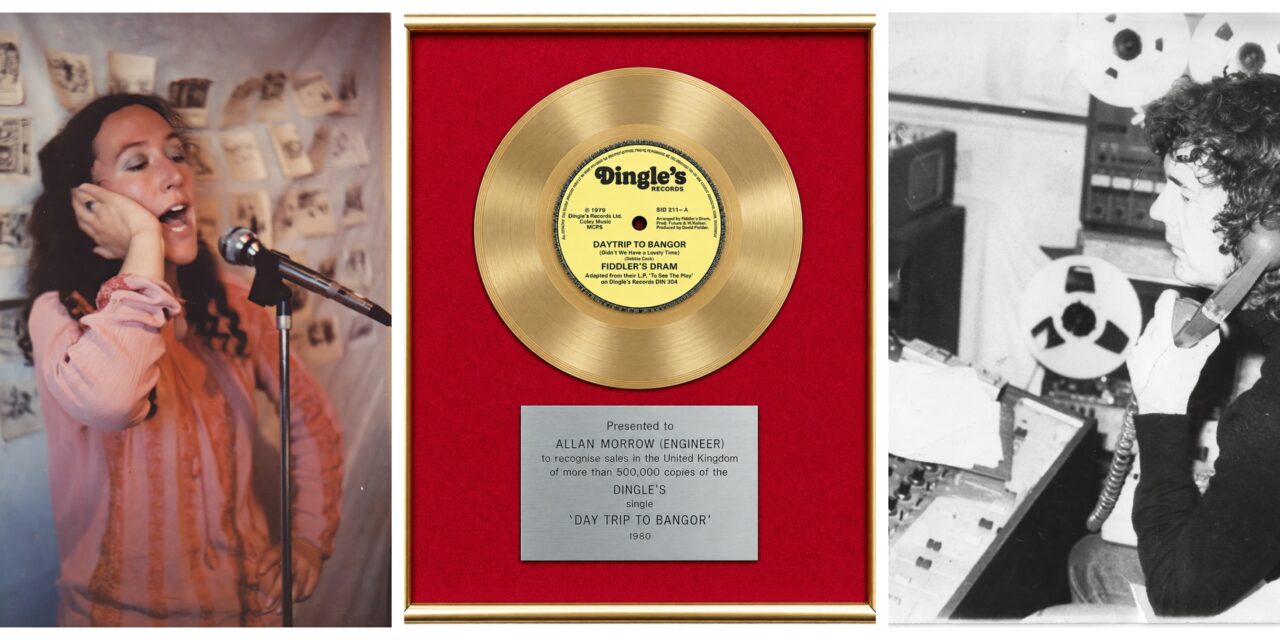
It became one of the most instantly recognisable songs of the late 1970s, sold more than half a million copies and took the name of Bangor around the world. But the story behind Fiddler’s Dram’s unlikely hit is every bit as colourful as the song itself – involving a tiny home studio, three different versions, a last-minute Musicians’ Union membership, a BBC limousine, copious amounts of beer and even a painful encounter with a doorframe.
Now, more than 45 years later, Allan Morrow, who recorded ‘Day Trip to Bangor’ and later found himself appearing with Fiddler’s Dram on Top of the Pops, has been recalling the remarkable inside story of how the record was made and became an unlikely chart hit.
Sharing his memories, personal photographs and archive material with The Bangor Aye, Allan takes us back to the late 1970s and a story that began about as far away from the glamorous world of the music industry as you could imagine.
From a small record label to an unlikely hit
In the late 1970s, Allan had built a great deal of sound-recording equipment at home and became involved with a very small record label, principally producing folk albums. It was a modest operation where, as Allan remembers, sales of a thousand copies would have been considered remarkable.

In 1978 they recorded Fiddler’s Dram’s album ‘To See the Play’, which included an early version of Day Trip to Bangor. It was considerably slower than the single that would eventually become famous and featured different instrumentation.
Allan and those involved with the recording became friendly with the band and noticed something when they saw them performing live.
“On seeing them perform live [we] noted how well ‘Bangor’ was received, and the idea of releasing it as a single was born.”
Turning it into a single wasn’t simply a matter of releasing the version they already had. The song went through three different versions before the familiar recording was finally chosen. Because it had a summery feel and mentioned a brass band, a brass arrangement was initially added, but it still seemed to be lacking something. A further version featuring a huge chorus was then tried, although Allan recalls that this “got a bit out of hand” and ended up sounding like a rather ragged crowd at Wembley Stadium.
Eventually, a much faster version was recorded using synthesisers and drums alongside banjo, fiddle, bassoon and clarinet. That became the hit single, but reaching that point had taken time – Allan estimates they spent around a year “tinkering” with the song.
Allan himself also ended up playing a very small part on the finished recording. Two notes of percussion needed to be added and, unable to remember whether nobody else was around or simply nobody else wanted to do it, he played them himself.
His contribution was supposed to earn him a sleeve credit for “Additional Percussion”, but somehow it appeared instead as “Allan Morrow – Occasional Percussion.”
“This amused me, so was left as it was.”
Getting ‘Bangor’ on the radio
For a small record company attempting to break a single in the late 1970s, radio airplay was crucial. Major companies could spend large sums employing specialist “pluggers” to bring their records to the attention of radio stations, but the operation behind Day Trip to Bangor had a rather simpler approach.
“We knew someone who worked at Capital Radio who might just have slipped our record into the pile that was going to be listened to when determining the following week’s playlist!”
As Allan puts it: “Small action, big consequence!”
There were soon signs that something unusual was happening. Michael Aspel and Kenny Everett played the song on Capital Radio, while broadcaster Dave Cash became particularly enthusiastic about it.
“Then Dave Cash ‘championed’ the song – even broadcasting singing along to it in the Capital canteen with about 20 others. Fine man!”
As the record began “bubbling under”, Allan would sit at home with two radios switched on simultaneously – one tuned to BBC Radio 1 and the other to Capital Radio – listening out for Day Trip to Bangor.
On one particularly memorable occasion, the song was played on both stations at the same time. Allan jumped in the air with glee, only to hit his head on the top of the doorframe and collapse in a heap on the floor. The subsequent headache, he admits, took some of the shine off the moment.
Songwriter Debbie Cook initially missed the excitement surrounding the release altogether. Allan recalls that Debbie wasn’t even aware the record had been released on the day it came out because she was giving birth, and was presumably rather occupied with her new baby for some time afterwards.
The call from Top of the Pops
As the record climbed the charts, Fiddler’s Dram received an invitation to appear on Top of the Pops – the kind of television exposure that could transform the fortunes of a record in those days. The band invited Allan to join them and, as he recalls, “Of course I wasn’t going to turn that down!”
There was, however, one complication. Anyone appearing as a musician on the programme had to be a member of the Musicians’ Union, and Allan wasn’t. He contacted the union and was told they would be pleased to have him join, but that processing the paperwork would take around two weeks. The problem was that Allan needed his membership the day after next.

Fortunately, he knew a Musicians’ Union branch secretary who was able to arrange what Allan describes as a “speedy (and possibly slightly unofficial)” admission to the union. That solved one problem, but filling in the application form presented another when he reached the question: “What sort of musician are you?”
“I thought ‘this is awkward’. Can’t put down ‘non-musician’ as that would be a nonsense, so crossed my fingers, which I believe negates a lie, and put ‘Drummer’.”
There was a potential drawback to his newly invented profession. Musicians’ details appeared in the union handbook and Allan realised someone might telephone offering him work as a drummer. In that event, he reasoned, he would either have to claim he was fully booked for the next five years or, more truthfully, ask them to call back in five years once he had learned how to play the drums.
Ironically, after all the effort involved in joining, nobody at the BBC asked to see his Musicians’ Union membership card.
A BBC limousine arrives at Allan’s home
There was another requirement before the band could appear on Top of the Pops. A special backing track had to be produced for the BBC containing everything except Cathy Lesurf’s lead vocal, which she would sing live.
The recording and mixing had to be completed in a single three-hour session, requiring rather more discipline than Allan and the others were accustomed to. The BBC sent someone along to oversee proceedings, and his arrival at Allan’s modest semi-detached home provided another memorable moment.
The BBC representative turned up in a chauffeur-driven limousine.
“Evidently his driver, seeing my tiny house asked, ‘Shall I check this is the right address sir?’”
With some concern that they might not complete the recording within the allotted three hours, Allan and the others came up with an unconventional insurance policy.
“We weren’t sure if we could do the recording in time, so plied him with copious amounts of beer in the hope he wouldn’t notice an overrun.”
In the event, no such distraction was required. They completed the backing track with around two minutes to spare.
‘Top of the Pops was a hoot’
Allan remembers appearing on Top of the Pops with great affection, although he readily admits that his own role wasn’t particularly demanding.
“Top of the Pops was a hoot to do, especially in my case as was just miming in the chorus, which requires very little effort.”
What surprised him was just how tightly organised the programme was. Until then, Allan had assumed it was largely put together as it went along, but the reality was very different, with cameramen carrying detailed lists of instructions and numerous run-throughs required before the programme was recorded.
For the musicians, that meant arriving at what Allan remembers as the distinctly unfriendly hour of around 7.30am. A large number of stand-ins were initially used in place of performers who had yet to arrive.
The repeated rehearsals had an unintended effect on Allan. With each run-through he found himself putting more effort into his performance, with increasingly enthusiastic results.
“By the time of the actual recording my shoulder-sway movements were quite ridiculous – something my son never fails to tease me about!” He saw a number of OTT performances in the years following, before the programme ceased transmission in 2006, and still thinks mine is the daftest!
Allan also remembers what he wore for the performance, although the reasons for the choice are now entirely unclear. He wore a T-shirt with a large picture of a cross-eyed frog on the front. Coupled with his wild permed hair, it was probably enough to frighten children!
Another memorable moment came when word spread that Legs & Co, the programme’s famous dance troupe, were about to rehearse. The prospect of seeing them perform at close quarters had considerable appeal to the young Allan, but on this particular occasion they were dancing around a map of Britain to Status Quo’s Living on an Island – while wearing full-length skirts.
“My hopes were dashed!”
Even after Fiddler’s Dram had completed their performance, things didn’t go entirely to plan. They were asked to wait because engineers suspected there might have been a technical problem with the recording, and a replay confirmed their suspicions. The picture was completely green, meaning the performance had to be recorded all over again.
Chart Success
The effect of appearing on Top of the Pops soon became apparent. At the time Fiddler’s Dram recorded the programme, Day Trip to Bangor was at number 26 in the charts. By that weekend, it had climbed all the way to number four, before peaking at number three the following week.

Despite suddenly finding himself on one of the biggest television programmes in the country, Allan was back at his normal job the following day. Someone who knew about his involvement remarked, “You’ve had your fifteen minutes of fame then,” to which Allan replied: “More like fifteen seconds, I reckon.”
A few days later, a cheque arrived from the BBC for £90 – roughly equivalent to Allan’s entire weekly salary at the time.
“Of course, I’d have paid the BBC that amount to have done it, but didn’t tell them that!”
The record went on to sell more than half a million copies, qualifying for a gold disc, which Allan received as the recording engineer rather than as “He Who Played Two Notes”, and completing an extraordinary transformation for a song produced by what Allan describes as probably “the world’s smallest record company”.
Bangor was always Bangor
With Day Trip to Bangor now a major hit, attention inevitably turned towards the city whose name was being sung across Britain.
Over the years, there has been some debate over whether the song was actually about Bangor or had originally been inspired by a trip to Rhyl, with contemporary newspaper reports claiming that “Rhyl” had been changed to “Bangor” because it fitted the song better. However, songwriter Debbie Cook has since been categorical that this was not the case.
Speaking in a BBC Radio 4 interview in 2011, Cook said the song was “absolutely about Bangor, North Wales”, adding that at the time she had been unaware there were other places called Bangor.
“I was so ignorant I didn’t know any other Bangors existed, so it was categorically Bangor (Wales).”
Cook explained that she chose Bangor simply because the name “scanned” and because it was the only place she knew along the North Wales coast. She was equally clear about the suggestion that the song had originally been about Rhyl, saying: “I’d never been to Rhyl in my life.”
The Rhyl story, she said, had come from newspapers and the local council rather than from her. Cook even demonstrated why the alternative wouldn’t have worked: “Didn’t we have a lovely time when we went to Rhyl… It doesn’t work at all.”
So, according to the woman who actually wrote the song, Bangor was always Bangor (Wales).
By then, the city’s name was travelling considerably further than North Wales. One contemporary newspaper report told how Bangor councillor Goronwy Wynne Jones received a telephone call from a radio station in Sydney, Australia, where the record was climbing the charts, asking him for information about the city.
Bangor finally gets its day trip
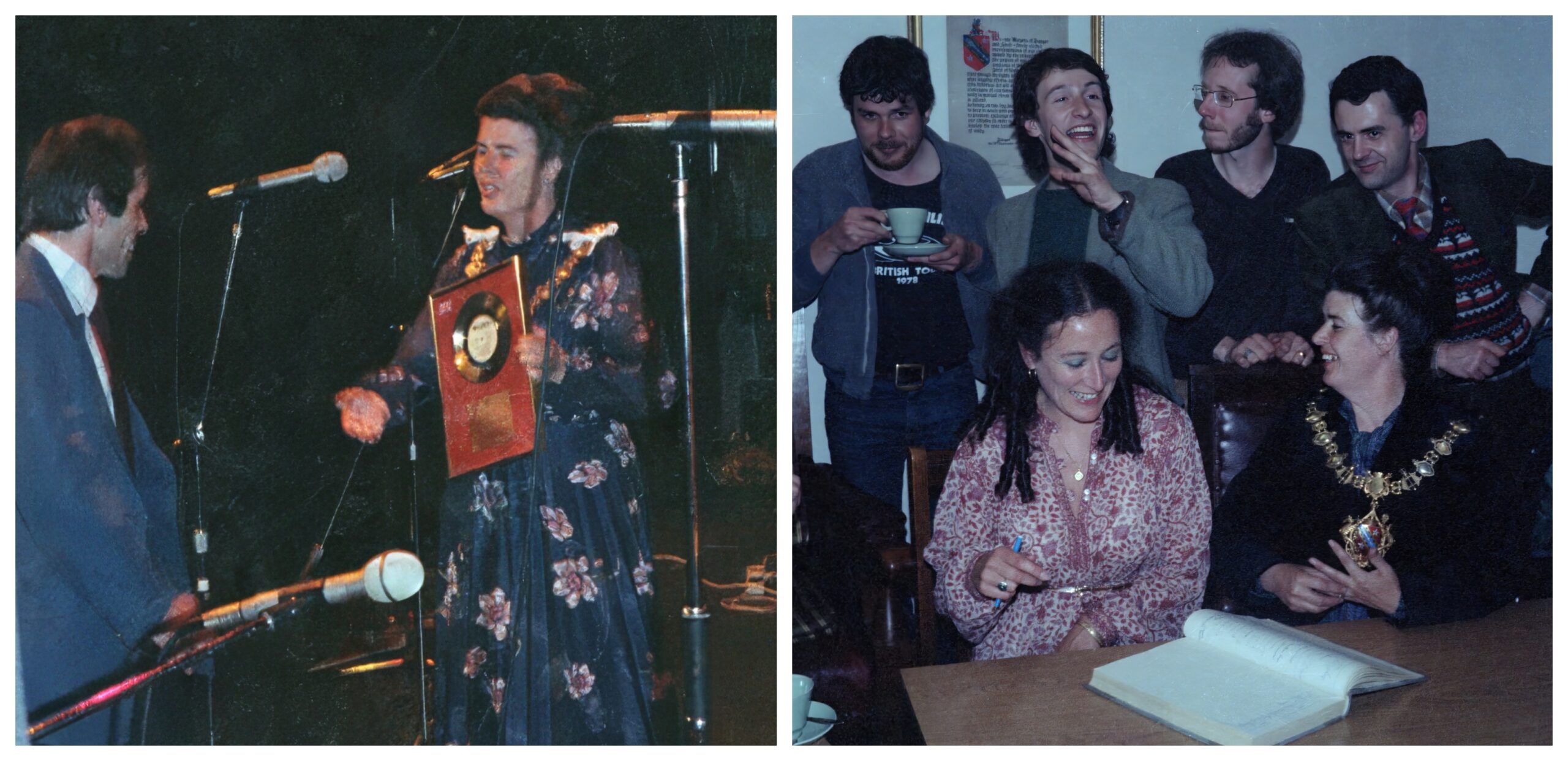
Plans were soon being discussed for Fiddler’s Dram to make a real visit to Bangor, and Allan recalls that a concert was suggested along with a mini civic reception hosted by the city’s lady mayor, who would present the gold discs.
That visit finally took place in May 1980.“A lovely occasion with very hospitable people.”
Debbie Cook was among those who attended. Allan recalls that the song which had caused all this excitement had taken her only around 20 minutes to write.
Cook would later become known for an entirely different kind of writing, contributing scripts to EastEnders and The Archers. Her connection with Allan also produced another curious recording story when The Archers featured a plot in which “Jack the Lad” character Eddie Grundy released a record.
Allan made the recording for real, but there was a slight marketing problem: most listeners apparently thought the record existed only as part of the fictional storyline.
“Unfortunately, most people were unaware that a real record existed, thinking it was just part of the storyline, so it only sold about three copies!”
‘An air of unreality’
Looking back more than 45 years later, perhaps the most remarkable aspect of Day Trip to Bangor is just how unlikely its success was.
It began with a very small record label accustomed to modest sales, home-built recording equipment and a song that had already appeared in a slower form on a folk album. It then spent around a year being reworked before a faster version emerged, combining synthesisers and drums with fiddle, banjo, bassoon and clarinet.
A fortunate opportunity at Capital Radio helped get it heard, broadcasters began championing it, Top of the Pops followed and a record produced on a tiny scale suddenly sold more than half a million copies.
For Allan, the whole extraordinary period still has what he describes as “an air of unreality”, and one comment from the time remains among his favourites.
Someone once told him:
“I can’t tell you how many pubs that song has driven me out of.”
Allan thinks he replied “sorry”.
But, as he admits:
“Not really sorry!”
More than four decades later, Day Trip to Bangor remains instantly associated with the city whose name happened to fit the song better than Rhyl. What began as an unlikely single from a tiny record company became a number-three hit, earned a gold disc and took Bangor’s name around the world – while leaving Allan Morrow with a collection of memories that includes Top of the Pops, a BBC limousine, an accidental percussion credit and one particularly painful celebration beneath a doorframe.
With thanks to Allan Morrow for sharing his memories, photographs and archive material with The Bangor Aye.
Photos: (1) Main Photo: Cathy Lesurf at the microphone. The Gold Disc presented to Allan Morrow. Allan at the ‘recording studio’ in his front room. (2) Allan Morrow (3) Band members Chris Taylor and Ian Telfer with the fiddle and the frog (4) Day Trip to Bangor vinyl record. (5)The band performed at Theatr Gwynedd in Bangor, where they recieved their gold discs and later attended a reception at Bangor City Council.

