
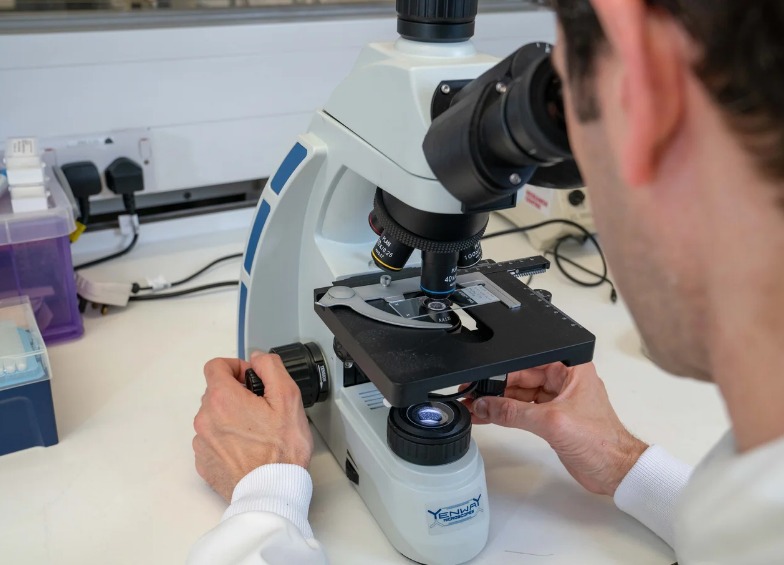
Researchers at Bangor University are working to gain a better understanding of how breast cancers caused by the inherited altered BRCA1 gene survive so they can use this knowledge to develop new treatments, thanks to new funding from Breast Cancer Now.
Cells in the body constantly repair damage to their DNA, and BRCA1 and BRCA2 genes play a crucial role in this process. When one of these genes is altered, DNA damage doesn’t get fixed properly. This can cause DNA changes to build up over time, increasing the risk of breast cancer and other cancers.
Women with an altered BRCA1 gene have a 60-90% risk of developing breast cancer.
Dr Christopher Staples at Bangor University has been awarded £169,622 to investigate how breast cancers with changes in the BRCA1 gene interact with the immune system, and how a specific protein may help these cancer cells survive.
Over the last decade, it has become clear that DNA damage in cells and problems with repairing it can impact the immune system and cause inflammation. While sometimes cancer cells can use this situation to their advantage, it also provides a potential new opportunity to intervene and treat cancer.
Dr Staples and his PhD student, Lauren Wilson, want to understand how this process affects breast cancers with changes in the BRCA1 gene. They’re studying how these cancers interact with the immune system to find new ways to treat them.
In previous research, Dr Staples’ team found that a protein called IFI16, which allows cells to detect damaged DNA and stimulate inflammation, plays a key role in helping ovarian cancers with an altered BRCA1 gene to survive.
In this new project, the team will investigate whether IFI16 plays a similar role in breast cancer.
The team is also collaborating with other researchers to study the structure of this protein in action, with the long-term goal of targeting it with new drugs to treat people with cancers caused by an altered BRCA1 gene.
Dr Christopher Staples from Bangor University said: “Inheriting an altered BRCA1 gene significantly increases your chances of getting breast cancer and some other cancers too. While targeted treatments like olaparib have been a gamechanger, cancers still find ways around them. So we’re studying how breast cancers with BRCA1 gene changes affect the immune system to find new ways to treat these cancers.”
Dr Simon Vincent, chief scientific officer at Breast Cancer Now said: “Each year, around 55,000 people in the UK find out they have breast cancer. We know that inheriting an altered gene, like BRCA1 or BRCA2, is the underlying cause for about 5 to 10% of breast cancers.
“For families affected by inherited altered genes it can be very distressing to know you’re at higher risk of a breast cancer diagnosis, and also to know that these gene changes may be passed on to future generations.
“That’s why Breast Cancer Now is funding this research to find new treatments for breast cancers that run in families and change the future of people with an inherited altered gene.”
For more information visit: The UK’s leading breast cancer charity | Breast Cancer Now
Breast Cancer Now is the UK’s leading breast cancer charity. Speak to our expert nurses now by calling our free, confidential helpline on 0808 800 6000 or visit https://forum.breastcancernow.org/

